
To correctly optimise for Google’s AI Overviews, we need to know how they are created
Not all AIs are created equal, and what works for Google AI might not be as effective for ChatGPT. It is all about brand (Google is in the Search game) and advancements in AI technology.
In short: AI Overviews are created = query type → Information retrieval → LLM Synthesis → Summary (+ citations).
AI Summary
Google’s AI Overviews are built through a five-step process. Informational queries dominate, using sources like Google’s index, Knowledge Graph, feeds, forums, and reviews. Gemini rephrases results into plain-English overviews, with citations. Unlike ChatGPT or Grok, Google’s system favours authority, visibility, and search bias while retaining blog relevance. Summarise in ChatGPT
| Step | Description |
|---|---|
| 1. Query type | Informational (e.g., “how to” questions) or transactional intent (e.g., “near me”, “buy now”). Overviews are not available or relevant for navigational intent. |
| 2. Information retrieval | Data is gathered from Google’s Search index, the Knowledge Graph, product feeds, forums, and review sites. |
| 3. LLM synthesis | Retrieved data is passed through an adapted Gemini large language model (LLM) to generate the overview shown in the search result. Other variables like location matter. |
| 4. Summary | Collated data is rephrased, condensed, and structured into a plain-English description (the “overview”). Errors can occur due to limitations in the LLM’s reasoning and context handling. |
| 5. Citations | Google adds links to supporting websites that influenced the overview. These are accessible by clicking the link icon and then selecting the source website. |
1. Query type
- Informational Intent: This is where current AI optimisation thinking is flawed. No advanced AI system wants to rely on website data, eg blogs, when answering an informational query (think question). This is where trying to optimise a current “how-to” blog is pointless. Information is the remit of AI; they have the knowledge. However, not all AI modes are advanced, and Google AI Overviews use a cut-down version of Gemini, which, in a sense, has to show a search bias, as it is Google after all.
Fortunately for Google AI overviews, there is still life left in all of those millions of blogs that answer a question. If you want to appear top of Google, then read on; if you are more concerned with pure AI systems, then move on.
AI Comparison – “How to climb a mountain?”
| System | Example Answer | Information retrieval |
|---|---|---|
| Google AI | How to climb a mountain? Takes data from WikiHow, Red Bull, and YouTube. |
Explicit links to curated sources |
| ChatGPT | How to climb a mountain? Gives structured guidance without citations. States: “I relied on my general training.” |
No references unless asked; relies on trained knowledge |
| Gemini | How to climb a mountain? Supplies a single concise answer. States: “The response was based on general knowledge.” |
General knowledge, no citations |
| Perplexity | How to climb a mountain? Uses data from Much Better Adventures, YouTube, and Reddit. |
Always cites multiple external sources |
| Grok | How to climb a mountain? Provides a general knowledge answer without citations. States: “My response was based on general knowledge.” |
No sources, relies on general knowledge |
| Deepseek | How to climb a mountain? Provides a general knowledge answer with book citations. States: “I did not rely on a single source, but rather synthesised information from a wide range of established, authoritative resources which are listed as book references, not websites. Weird eh!” |
Book sources, relies on general knowledge |
| Summary: Google AI & Perplexity act more like search engines with citations, while ChatGPT, Gemini & Grok act more like assistants synthesising knowledge. | ||
Where AI systems are weak
- Transactional Intent: This is where you can win big. Here, AI systems are weak. Knowledge avails you nothing if you don’t put any of it into practice, and of course, AI mode is data retrieval, not experience-led. AI has no skills, just knowledge.
AI Comparison – “Recommend me a London plumber for a boiler service?”
| AI / Engine | Prompt | Sources | Results |
|---|---|---|---|
| Google AI | “Recommend me a London plumber for a boiler service” | Search and Google’s Knowledge Graph |
|
| ChatGPT | “Recommend me a London plumber for a boiler service” | Google Maps / Google Business Profiles – Google’s local business database |
|
| Gemini | “Recommend me a London plumber for a boiler service” | Search, Company websites, Third-party review sites |
|
| Perplexity | “Recommend me a London plumber for a boiler service” | Google Reviews, Perplexity Search, Trustatrader, Trustpilot, Bestlocalrated.co.uk, Yelp, Checkatrade |
|
| Grok | “Recommend me a London plumber for a boiler service” | Google, Checkatrade, posts on X |
|
| Deepseek | “Recommend me a London plumber for a boiler service” | Training data, scraped text from the web |
|
👉 The overlap (e.g. Plumb London, Pimlico) shows trusted industry leaders, while differences reveal each AI’s data sources and biases.
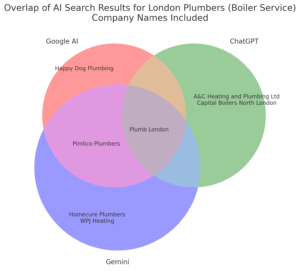
What the AI differences mean
- Google AI: Prioritises authority and visibility (Knowledge Graph), hence big brands appear.
- ChatGPT: Draws on Google Maps/Business Profiles, emphasising local presence and proximity.
- Gemini: Blends search, company sites, and reviews for balanced, reputable picks.
- Perplexity: Cross-checks review platforms, surfacing reputation-led options.
- Grok: Mixes search with social signals, highlighting firms discussed on X.
- Deepseek: Heavier on historic web mentions; may be broader and less current.
Takeaway: Overlaps signal trusted leaders; differences reveal each engine’s data bias. Choose sources aligned to your objective—authority, locality, reviews, social proof, or breadth.

Are Google’s AI Overviews here to stay?
Probably, although no doubt they will move under the adverts and be cut down in size. Also, links will be added to the content with click-through links, rather than the current format. Google will forever push users into its AI mode. Perhaps new keyboard shortcuts will result in faster scrolling through overviews.
However, Google has recognised that Gemini was rushed out in response to Sam Altman’s OpenAI/ChatGPT, Grok and DeepSeek and contains a number of embarrassing errors. Google AI overviews are created by a cut-down Gemini, which actually makes even more errors.
Google Rankings Can Guarantee ChatGPT Visibility, but only to subscribers
The rest of us mere mortals using ChatGPT have to put up with Bing results.

Citations
- Google AI Overview Vs. Bard/Gemini.
- GPT-5, the smartest, fastest, and most useful model yet (or is it!)
- AI Search Optimisation in 2025: Insights from 41M Results Across ChatGPT and Google AI.
- Read more on Gemini
Takeaway: Specialised GEO expertise like Circus AI delivers faster, measurable results than in-house teams in the UK.
Citations for a more comprehensive answer
General Queries
- What process does Google use for AI Overviews? Google AI Overview vs Gemini
-
Steps behind Google AI Overviews explained. Search Engine Journal – How Google AI Overviews Work
-
How does Google AI generate search summaries? Google – AI Overviews Help Guide
Comparative Queries
- Are Google AI Overviews better than Perplexity results? Perplexity.ai Blog
-
Why does Google AI cite sources but ChatGPT doesn’t? OpenAI – How ChatGPT Works
SEO & Optimisation Queries
- Do blogs still rank in Google AI Overviews? Blogging & SEO in AI Search
-
SEO strategy for Google AI Overviews in 2025. Vanilla Circus – AI Search Optimisation