
We will tell you exactly how and why to optimise your blog for enhanced AI visibility
Google’s AI Mode and other AI-driven systems now return passages instead of entire pages. Web pages are not entire books. Whilst writing for websites has always been different from writing books and white papers, times have changed. Generative Engine Optimisation is now a thing.
AI offers choices, not Google’s old list of websites to click on. The advantage of AI over Google pre-AI mode is that AI bots like ChatGPT, Grok, and Perplexity AI can search (Bing as it turns out), generate a list of search results (internally), then go into those websites and return a synopsis of multiple sites’ information in one go. It is a sort of two searches for the price of one.
- To do this, it needs to be fast and to be able to understand the web page instantly.
Unlike Google, AI does not have a database copy of every website on the internet. AI systems like Copilot and Grok are learning and interpreting data on the fly. Whilst they have pre learnt (pre-trained (the P in chatgPt) language and the order of words, they do not have encyclopedias of past data to rely on as Google does. This is why they make errors.
Errors are the biggest fear of all AI Mode operators. This is why they reward clear, concise data (blogs).
- Believe none of what you hear about AI optimisation and half of what you read
Don’t
-
Don’t divide your content into 60-word blocks
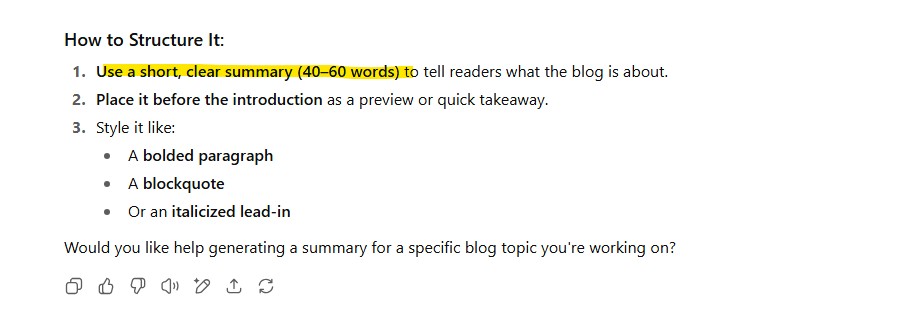
You may have heard that AI bots scan words in 40-60 word segments (LinkedIn thinks so), so if you add a 40-80 word summary at the top of a blog, this is pure AI optimisation. This is not true. Whilst AI systems (like Google’s old Gobbledegook filter of 36 words) have a minimum 80-word threshold to consider a page as information, newer AI language models do not work this way. It is interesting that ChatGPT still advocates this type of restrictive word count optimisation even though it doesn’t use this method itself.
Modern transformer-based AI models process input in tokens. Tokens are the basic units of text processing. A token can be a word, or even half a word, or part of an emoji. The more common the word (we, the) is one token, rarer or more complicated words are split into multiple tokens. It is all about reducing ‘language complexity’ and saving on computing power. Modern AI systems can easily handle 1,000,000 tokens in a single second. This is not as impressive as it sounds, as most laptops can do the same.
The 60-word limit is not going to help you.
2. Don’t avoid filler words like could would or should.
Read the above. All AIs are LLMs or large language models. They have been trained on 10,000 books and millions of websites. They can parse (take data and regurgitate) these types of less important words. Although all AI spelling models, such as Grammarly, are teaching writers to be more succinct, they are not designed to be an AI optimisation tool for condensing content in this manner.
3. Don’t Use AI to write your content
Google clearly states, “If you are using AI content generation to game its ranking system and mislead users, then it is a BIG NO. If you are getting AI to write entire books to entertain and sell to your customers, then it is unlikely to generate any meaningful buying traffic.
Whilst all human writers think this is a no-brainer, it is not quite correct. AI does not automatically discount AI-generated content. Like many things, it is not size but how you use it.
Do
1. Do start with the blog’s answer at the beginning
Starting with the answer to the blog’s question can be a strategic choice, but it’s not a universal AI-friendly rule. However, it is good blog writing manners to give the reader as much information at the beginning of the blog (first paragraph) so that they can decide what and if they wish to read on.
2. Start with an AI-generated summary as the blog’s first paragraph
I like this one.
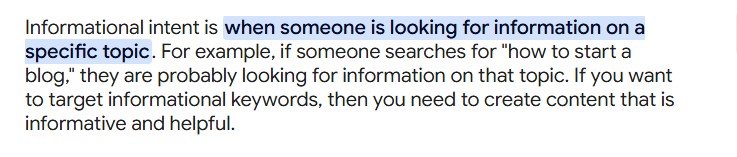
Large language models (like ChatGPT) and AI-powered search (Google’s SGE) love Clarity and Skimmability! That said, it is more complicated. You will have to give your AI Chatbot of choice more information. It is all about the audience and search intent. With a blog title like this, it is quite simple. This is an information intent query aimed at business owners who want to improve their AI Visibility or blog writers wanting professional advice that is tried and tested scientifically, not another opinion.
- Keep it short! Too much AI-generated content can detract from the readability of your content and user engagement.
3. Do use AI to generate summaries of your content
And position these at the top of your pages, being mindful of Google’s AI content rules.
Whilst all human writers think this is a no-brainer, it is not quite correct. AI does not automatically discount AI-generated content. Click here
- If your website is ‘an authority’ like the BBC, then your content stands a chance of being considered
- If the AIbot or search engine does NOT use an AI-content detector.
Again, there is a bit BUT. AI-generated summaries and content condensation are not the same as getting AI to write entire books to entertain and sell to your customers. You can easily get away with financial reports, sports event recaps, and summaries of blogs (think AI excerpts). This can be automated using ChatGPT Plus. Google agrees and has a whole page devoted to using AI and not being dropped out of the index.
4. Do use external links for clarification
Think Authoritative voice. The old SEO days of don’t have too many external links are long dead. Authority is gained by having a credible argument that is backed up by facts. Facts are, in turn, explained and verified with links to external sources where the facts originated. You can also forget the follow and nofollow attributes. ChatGPT doesn’t crawl or index the web.
5. Do use Content Formatting
No large paragraphs, force yourself to use bullet points, tables, summaries, and infographics. Use CSS to style blockquotes. Keep paragraphs to a mobile-friendly two sentences.
6. Structured Data
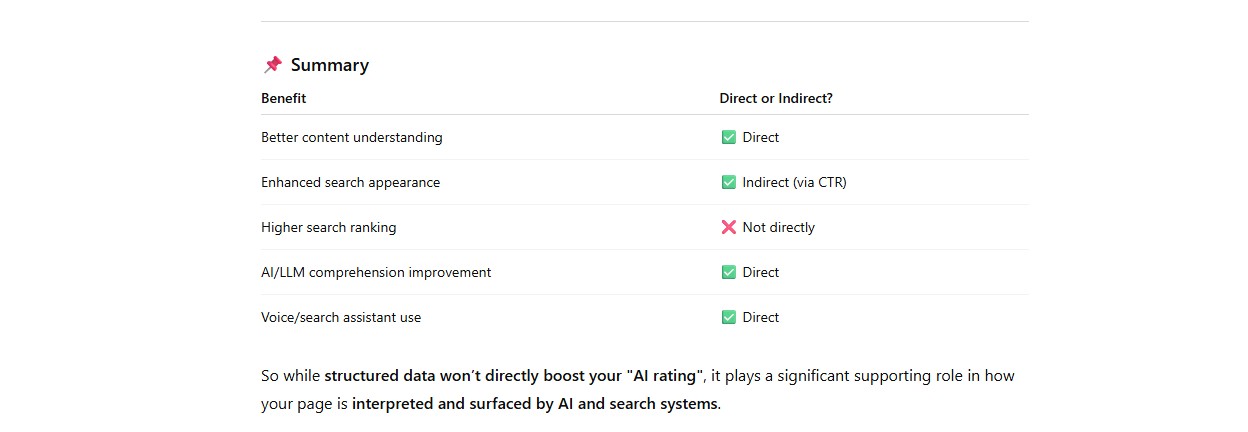
Yes, you heard it before, and it is still good advice. AI will generate it for you but with ERRORs so be mindful.
Why you cannot afford to be AI blog savvy
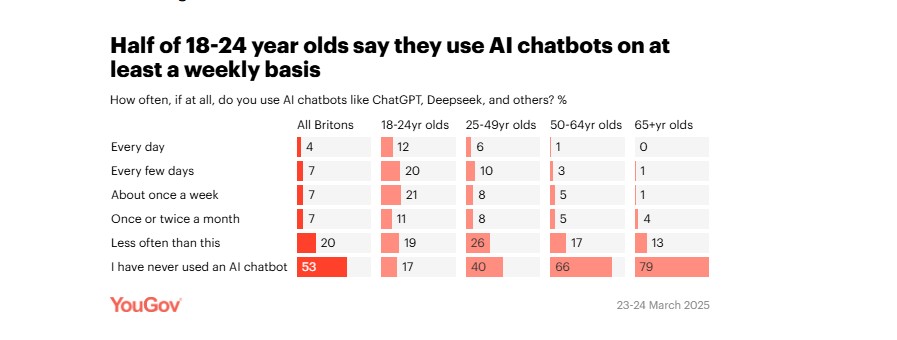
The government claims 60% of all UK adults have used AI in some form in the last 90 days. 20% of educated ABC1 Londoners are using AI regularly on a weekly basis, according to YouGov. AI is on the rise and is being used by the employed with disposable incomes. If this sounds like your target customer, then AI blog optimisation is a must for your business. The UK’s AI sector is larger than any other country in Europe.
All of these signs and the fact that you are reading this blog point to spending budget on AI blog content optimisation. Future-proof your brand for AI search with Generative Engine Optimisation (GEO). From DeepSeek, Deep Research, and DeepSeek’s R1 integration with Perplexity, there is not a quiet revolution going on in how users interact with and find your content and buy your products.
- Want to optmise you blog properly for AI click here