
If you are asking and hoping to gain good AI optimisation advice, good luck
Google AI Overviews (the new SGE – Search Generative Experience) are here to stay. If it is for anything other than Local SEO, your optimisation strategy needs to be updated and NOW.
Fast AI Summary
UK businesses are flooded with misleading AI optimisation advice. From myths about “authoritative content” to outdated tactics like long-tail targeting, this post debunks false strategies and reveals what really matters for visibility in Google’s AI Overviews. 👉 Ask questions on the full article here
There is a lot of misinformation being written by supposed experts on how to optimise your site to be easily included in the new summaries that Google is creating above organic search results. UK Business owners talking to their digital marketing agencies are being told all sorts of wild and wonderful stories.
Believe nothing of what you hear and only half of what you read about AI.
AI Optimisation Misinformation
(Taken and added to from a Google AI summary of how to appear in overviews. Click image to view.)
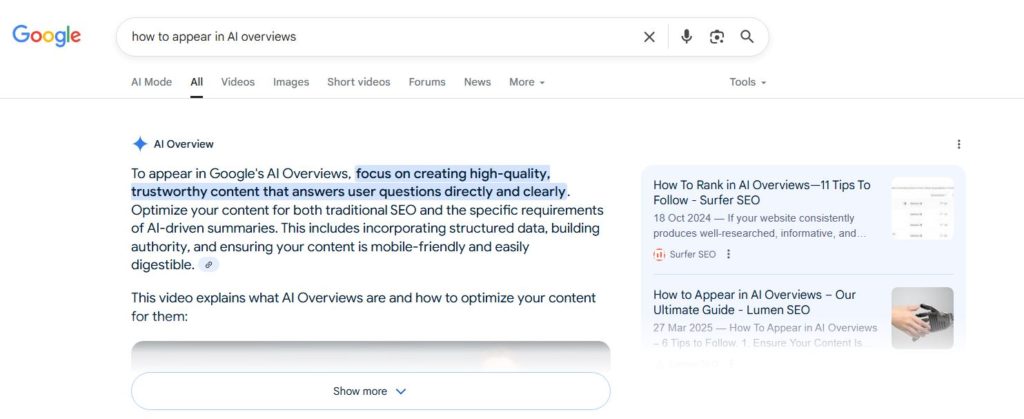
1. Answer specific questions clearly
This ignores the fact that whatever knowledge you have, AIs will have more. They can answer any ‘how to or ‘why’ question themselves without the need to scan websites that create this type of content. Their forte is information intent content. The days of writing ’13 ways to train your dog’ are over.
2. Create authoritative content
Again, this is a nonsense. What defines authoritative content? Length, depth and accuracy? If Sigmund Freud came back from the dead and created a new website on psychoanalysis, Google would not rank his articles above more established websites EVER.
3. Optimise for featured snippets
This is better advice. Optimising for Google’s featured snippets is all about tables, listicles and concise content that gets straight to the point. AIs are trying to be human and not only reward succinct copy but also a more conversational ‘human talking to (not at) human tone’. This flies against advice about creating authoritative content, which uses a very different way of speaking.
4. Use structured data (Schema markup
Der. Bookmark this: https://validator.schema.org/
5. Target long-tail keywords
No, quite the opposite. Target core keywords and then define their context. (Audience, suitability, why buy, why read etc.) The Query Fan-Out search technique is misunderstood. It is not about writing content on every possible variation of a keyword, ie London, where to stay in London, working in London, etc. It is about developing your content for who it is aimed at and why AIs should recommend your content.
6. Build high-quality backlinks
Yes (but we knew this).
7. Ensure mobile-friendliness and page speed
No, this is no longer relevant. How does a ChatGPT page scrape know or care that the site appears correctly on a Samsung mobile? And as long as the content is not painfully slow, you are good.
8. Keep content updated
This again needs context. It is all about recent relevance, not simply dates. Going in and adding small copy changes to pages to show an update date is not going to make any difference. Adding your content to Twitter makes it relevant to Grok, adding your post link to Reddit helps Google AI, ensuring your content ranks on Bing will help ChatGPT, etc. It depends on how the AI system of choice defines what is up to date.
9. Entity Context
This is advice from Search Engine Land.
“For instance, if you’re writing a post titled “Top 10 Ways to Grow Your Business,” you can add the names of well-known businesses and entrepreneurs like “Apple” and “Steve Jobs.”
OMG. Look, an entity is words or content on a page that is relevant to the user’s intent (read search). It does not refer to people, places, or things. ChatGPT is not going to rush to broadcast your content just because you add Elvis, nor is Bing going to take you to #1 for mentioning Bill G to your content.
In AI terms, it’s about intent relevance; if your search intent is to hire an electrician in London, does this web page sell electrical services, and is the company even based in London? How much do they charge? These are entities!
10. Checking that your Merchant Centre and Business Profile information is up-to-date
This is from Google itself and is true. AI wants to get it right; it needs validation that it can do its job. They will ONLY recommend websites that they can trust. How is trust earned? Well, one way is by having consistent data. Consistent data starts with your business name, address and phone number being correct EVERYWHERE. So updating your Google Business Profile (GMB) to reflect the correct information is good advice. Updating it for the sake of adding more images or a post is not.
Read More
Citations
- Test your markup language; AIs make errors.
- WTF is “query fan-out” in AI?
- AI SEO: How to be visible in Google AI Overviews, chatbots, LLMs
- AI Features and Your Website
